
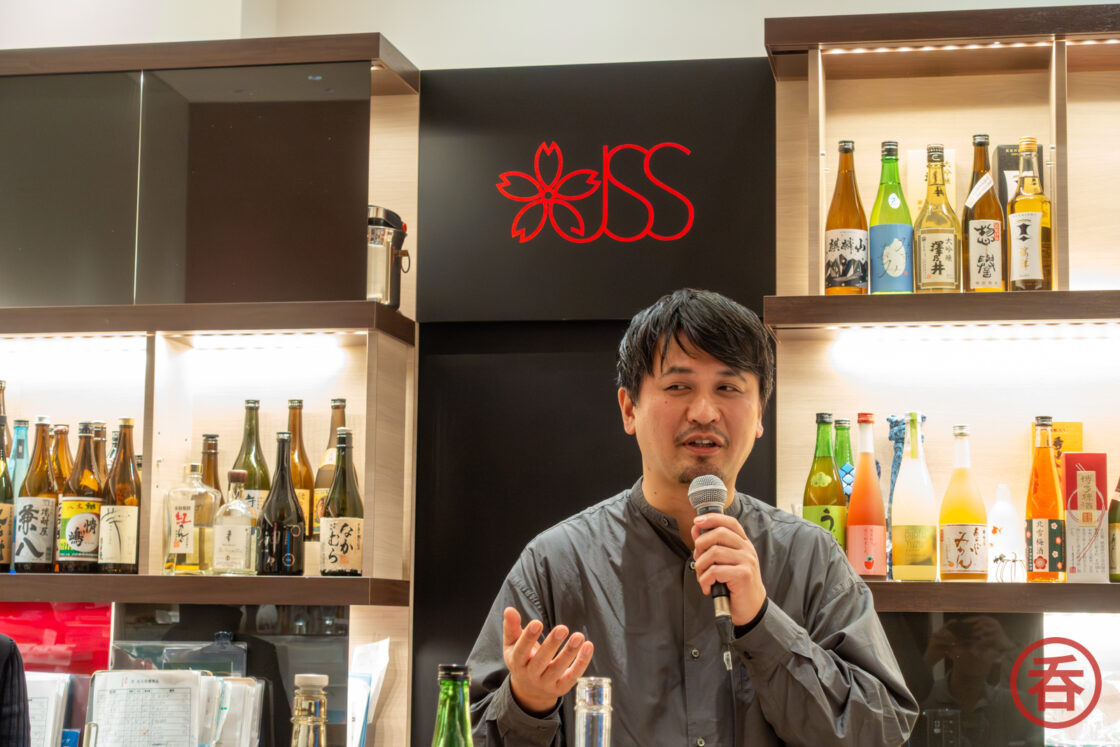
Once again, members of the press descended upon the Japan Sake and Shochu Information Center for a quick masterclass in hot sake. We walked away with a new appreciation for the world’s favorite(?) hot tipple!
You may recall that we attended a similar session back in April 2023. While that session covered history and techniques briefly, this session was a bit more technical.
This masterclass was run by Chef Jo Takasaki, who currently runs a restaurant in Tokyo called Takasaki no Okan, which offers a hot sake pairing course in the Ikejiri Ohashi neighborhood. He’s also the author of the Book of Atsukan, the first English-language book dedicated to warm sake, atsukan.
For Takasaki-san, atsukan is not just a drink, it’s a lifestyle. He says that modern life has put people’s private lives at odds with the realities of today’s economy. To address this dilemma, he suggests that a warm atsukan could drive innovation in global food culture. That’s why, in addition to Japan, he spends time in cities around the world spreading the word about the atsukan.
For the heating, Takasaki-san draws parallels between the heat transfer offered by the vessel and cooking styles.
- Glass beaker: The most gentle method of warming sake, similar to steaming in cooking
- Tin: Adds roundness and is similar to stewing/simmering
- Copper: The quickest for heat transfer — similar to grilling
- Stainless steel: Crisp, quick heat — similar to frying
- Titanium: Pure and fast, like cooking over firewood
Just like in cooking, sometimes you want to apply heat quickly, and sometimes you want to apply it slowly. To that end, he uses two hot water baths: one at 60°C and another at 90°C.
Sake these days, he says, is typically served cold or at room temperature. How do you know which vessel to use for which sake? This seems largely down to experimentation, as even similar styles of sake respond differently to heat.


Instead of going out and buying all five of the above vessels, though, he suggests you can start experimenting at home with even a coffee mug. From there, you can graduate to a glass beaker, then a tokkuri.
One thing I’ve always wondered about atsukan as a drinker: how quickly should we be drinking it? If the chef is going through all the trouble of getting the serving temperature right, wouldn’t it be a shame to sit on the izakaya table and be lukewarm after, say, 15-20 minutes?
Luckily, I had the opportunity to ask that during the Q&A session.
It turns out it doesn’t matter. A well-prepared sake, he says, once heated, will remain a good sake even if it drops down to room temperature. (Note to self: drink better sake)
Takasaki-san also views atsukan as a way to combat global climate change. A warmed sake will heat you up during the summer, making you sweat and feel cooler, he says, enabling you to turn down the air conditioner by a few degrees. The cynical in me wonders how much energy is required to get that sake warm in the first place, but perhaps that’s best left to some experimentation.

Hi there! I created and run nomunication.jp. I’ve lived in Tokyo since 2008, and I am a certified Shochu Kikisake-shi/Shochu Sommelier (焼酎唎酒師), Cocktail Professor (カクテル検定1級), and I hold Whisky Kentei Levels 3 and JW (ウイスキー検定3級・JW級). I am a Trustee of the Japanese Whisky Promotion Committee. I also sit on the Executive Committees for the Tokyo Whisky & Spirits Competition and Japanese Whisky Day. Click here for more details about me and this site. Kampai!